

Summary:
- AI essay writers are most useful as model answers and learning tools: studying, comparing and questioning examples can improve understanding, self-monitoring and writing skills.
- The key distinction is collaboration versus delegation – using AI for ideas, structure, feedback and comparison can support learning, while submitting AI-generated work hands over the thinking and may breach university rules.
- The strongest approach is to draft your own work, compare it critically with AI examples, verify every claim and reference, and gradually reduce your reliance on AI as your skills improve.
Artificial intelligence has quietly become part of how students study. Tools such as Uniwriter, an AI writer recently reviewed by the BBC, can produce a complete, structured response to almost any assignment brief in seconds, and it would be naive to pretend students are not using them. The more useful question – the one this article sets out to answer – is not whether students should use AI essay writers, but how to use them in ways that genuinely improve grades, writing skill and confidence.
Fortunately, we do not have to guess. There is a substantial body of research on what happens when students learn from model answers and exemplars – essentially, worked examples of what a good assignment looks like. An AI-generated essay is, in effect, an instant, on-demand model answer. That means decades of evidence about exemplars can tell us precisely when AI-generated essays help students learn, and when they quietly undermine them. Add to this a growing consensus among the world’s leading universities about acceptable AI use, and a clear, practical picture emerges.
What the world’s top universities actually say
A common assumption is that universities have banned AI outright. The evidence says otherwise. A survey of the world’s top 50 universities (by QS ranking) found that 41 had published publicly available guidance on generative AI – and every single one of those permitted its use in academic settings, provided students followed certain conditions (Ullah, Bin Naeem and Kamel Boulos, 2024). This represents a striking shift: an earlier review found that fewer than half of top-ranked institutions had any guidance at all (Moorhouse, Yeo and Wan, 2023). Universities moved quickly from silence, through brief flirtations with prohibition, to structured permission.
The conditions attached to that permission are remarkably consistent. Most institutions ask students to secure their instructor’s approval before using AI in assessed work, to recognise situations where AI use is inappropriate, to acknowledge and credit AI tools properly, to verify AI outputs against reliable sources, and to protect personal data (Ullah, Bin Naeem and Kamel Boulos, 2024). The University of Edinburgh’s “golden rules” capture the spirit of most policies in one phrase: learn, don’t copy – use generative AI to aid your learning, but never paste its output into assessed work as your own.
Two practical points follow for any student using a tool like Uniwriter. First, the rules that matter are local: your course organiser’s instructions override any general principle, and roughly three quarters of top universities explicitly require instructor consent (Ullah, Bin Naeem and Kamel Boulos, 2024). Second, the direction of travel across the sector, echoed in the Russell Group’s shared principles, is towards building AI literacy rather than policing AI out of existence (Russell Group, 2023). Universities expect you to graduate into a workplace where AI is everywhere; they want you to use it intelligently, not secretly.
Collaborating, not delegating: a spectrum worth memorising
Perhaps the clearest way to think about acceptable AI use comes from Professor Laura Roberts of Worcester Polytechnic Institute’s Integrative and Global Studies Department, who co-designed AI policies with her students under the memorable banner “Collaborate! Don’t delegate!” (Roberts, no date). Her framework lays out six ways of completing an assignment along a spectrum, moving from fully collaborative to fully delegated:
- I completed the assignment without using AI.
- I used AI for ideas and research, and then I wrote the assignment.
- I wrote a draft and then used AI to improve my draft.
- I used AI to generate multiple drafts and used the best parts to create my draft.
- I generated a draft with AI and reviewed, edited and submitted it.
- AI wrote my draft and then I submitted it.
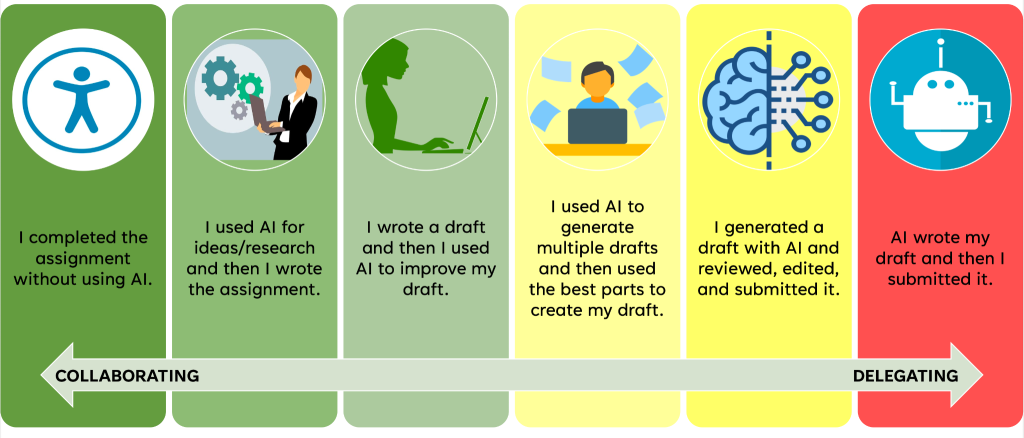
The first three sit firmly in the green “collaborating” zone; the last two drift into the red “delegating” zone. The underlying principle, as students on Roberts’ courses are told, is that although AI can be used for certain tasks, “students should not offload their learning to AI”.
What makes this spectrum so useful is that it shifts the conversation from a binary (did you use AI: yes or no?) to a question of cognitive ownership: who did the thinking? Notice that the dividing line is not whether AI touched the work – it is whether you remained the author of the ideas, the structure and the judgement. Using tools like Uniwriter to explore a topic, test an argument, or see what a well-organised answer looks like sits comfortably on the collaborative side. Generating an essay and then submitting it, however lightly edited, sits on the delegating side and, as the next sections show, the learning research suggests delegation is also simply a bad study strategy, quite apart from any policy issue.
Why model answers work: the learning science
Here is the insight most discussions of AI essay writers miss entirely: an AI-generated essay is a model answer, and model answers are one of the best-studied tools in education. Several established learning theories explain why they work – and, crucially, the conditions under which they work.
Scaffolding is the most directly relevant. In this tradition, support is defined as temporary assistance for tasks a learner cannot yet do alone, with that support gradually withdrawn as competence grows (Coffman, Iommi and Morrow, 2022). A model answer fits this definition well: it can break a daunting piece of academic performance into reachable steps and help a student move from assisted to independent work (Malik et al., 2025). Studies of scaffolded instruction report improved success, understanding, transfer and – importantly – independence compared with less-supported conditions (Gürel, 2025). The key word throughout is temporary. Scaffolding that never comes down is not scaffolding; it is a crutch.
Example-based learning provides a second rationale. Across both cognitive and social-cognitive research traditions, learners benefit from studying worked examples, particularly during the early stages of acquiring a skill (Gog and Rummel, 2010). Observing models has been shown to improve writing, mathematics and other academic skills, and studying multiple examples helps learners abstract the underlying principles rather than fixating on one surface pattern (Renkl, 2013). From a cognitive load perspective, worked examples also reduce the wasteful mental “search” that novices experience when facing an unfamiliar task, freeing attention for actual learning (Hoogerheide and Roelle, 2020).
Self-regulated learning completes the picture. Exemplars help students infer what the standard actually is, generate their own internal feedback, and monitor their work against a concrete reference point (To, Panadero and Carless, 2021). Foundational work in this tradition showed that simply observing a model at work improved students’ revision skill, self-efficacy and intrinsic interest in writing (Zimmerman and Kitsantas, 2002).
There is, however, a consistent caveat across all of these theories: model answers help when they are studied, discussed and compared – not when they are copied. Simply handing students a perfect answer can promote mimicry, passive acceptance, and the false belief that only one answer is correct (Greener, 2017). The theory, in other words, independently arrives at exactly the same conclusion as Roberts’ spectrum: collaborate with the example; do not delegate to it.
What the evidence shows in practice
Theory is one thing; results are another. A systematic review of forty studies on exemplar use in higher education concluded that exemplars help students understand expectations and can improve performance, particularly when combined with rubrics, discussion, peer assessment or self-assessment rather than delivered as static samples (To, Panadero and Carless, 2021). An integrative review in nursing education reached similar conclusions about exemplars supporting academic writing (Carter et al., 2018), and controlled experimental studies have found that exemplars improve writing outcomes relative to no-support conditions (Burnell et al., 2023; Lipnevich, Panadero and Calistro, 2022).
Beyond raw marks, exemplars appear to build the deeper capacities that make students better writers over time. First-year undergraduates working with exemplars reported gains in self-efficacy and self-monitoring (Hawe, Lightfoot and Dixon, 2017), and students describe feeling more agentic and less dependent on their tutor’s feedback after analysing exemplars against their own drafts (Nicol and Rose, 2025). One particularly practical finding from that recent work: comparing an exemplar with your work after you have drafted may be more powerful than reading it beforehand, because the comparison forces you to generate your own feedback.
The evidence is equally clear about what does not work. Passive exposure to a single “ideal” answer risks uncritical copying and reduced originality (Macbeth, 2010; Wu, 2019). And examples alone are sometimes insufficient: a medical education study found students still needed to practise writing and marking work themselves for performance to improve – exposure was not enough (Rashid-Doubell, O’Farrell and Fredericks, 2018). Dialogue and active use are what convert an example into learning; peer discussion and guided comparison help students transfer insights from exemplars into their own writing (To and Carless, 2016).
Putting it together: how to use AI writers like Uniwriter effectively
Read side by side, the university policies, the collaboration-delegation spectrum and the exemplar research converge on a single, practical playbook. Here is what it looks like for a tool such as Uniwriter.
- Check the local rules first. Before anything else, confirm what your module handbook and course organiser permit. Most leading universities require instructor approval for AI use in assessed work, and expectations differ between assignments even within one course (Ullah, Bin Naeem and Kamel Boulos, 2024). Thirty seconds of checking prevents months of trouble.
- Generate examples, not answers. Use the AI output as a worked example of structure, tone and argumentation – the same way lecturers have long used exemplars. Ask: how is this organised? How does each paragraph link evidence to a claim? What does the introduction promise and does the conclusion deliver it? You are studying the craft, not harvesting the content.
- Generate more than one. The example-based learning literature is clear that multiple, varied examples help learners abstract principles instead of imitating one surface form (Renkl, 2013). Prompt for two or three different responses to the same brief – different structures, different lines of argument — and compare them. Working out why one is stronger than another is precisely the evaluative judgement that predicts better writing (To, Panadero and Carless, 2021). Try using subject specific writers such as BusinessEssays.ai and LawWriter.ai for contrast (both built by the Uniwriter team).
- Draft first, compare after. The strongest recent evidence favours writing your own draft and then comparing it against an exemplar, generating your own feedback from the gap between the two (Nicol and Rose, 2025). This is the AI equivalent of collaborating rather than delegating: your ideas go on the page first, and the model answer becomes a mirror rather than a substitute.
- Interrogate, don’t accept. Verify claims, references and reasoning in any AI output against primary sources – nearly every university guideline surveyed demands critical evaluation and verification of AI-generated content, reflecting well-documented problems with accuracy and fabricated citations (Ullah, Bin Naeem and Kamel Boulos, 2024). Even for tools like Uniwriter that have been trained and developed alongside lecturers, you still need to treat the output as a clever but unreliable study partner whose confident assertions need checking.
- Keep a record. Around a third of top universities’ guidelines ask students to document their prompts and outputs, and over half explain how to credit AI tools by name, version and date (Ullah, Bin Naeem and Kamel Boulos, 2024). Even where it is not required, keeping this record protects you and, usefully, makes your own process visible to you.
- Take the scaffolding down. Scaffolding, by definition, fades (Coffman, Iommi and Morrow, 2022). If you needed three AI exemplars for your first essay of the year, aim to need one by the third, and none by the fifth. The whole point of a support is that you eventually stand without it – and exams, presentations and job interviews are all moments where you will have to.
A note on the delegating end of the spectrum
It is worth being straightforward about why steps five and six on Roberts’ spectrum – generating a draft with AI and submitting it, with or without editing – are a poor bargain, entirely apart from any integrity policy. The exemplar research shows that the measurable benefits of model answers come from active comparison, discussion and revision; passive receipt of a finished answer produces mimicry rather than learning (Greener, 2017; To and Carless, 2016). Delegate the draft and you delegate the gains: the improved self-monitoring, the sharpened judgement, the growing independence that studies consistently attribute to well-used exemplars simply never materialise (Hawe, Lightfoot and Dixon, 2017). You hand in an assignment and keep none of the skill it was designed to build – skill that the next, harder assignment will assume you have.
The bottom line
The arrival of AI essay writers has not changed what we know about learning; it has made that knowledge urgent. Model answers are among the best-evidenced tools in higher education – powerful when studied, compared and discussed; hollow when copied (To, Panadero and Carless, 2021; Greener, 2017). Tools such as Uniwriter put an infinite supply of on-demand model answers in every student’s pocket, and the world’s leading universities have, almost without exception, chosen to permit them within clear conditions rather than ban them (Ullah, Bin Naeem and Kamel Boulos, 2024).
The line that matters is the one Professor Roberts draws for her students: collaborate, don’t delegate. Use AI to generate examples, to test your ideas, to hold a mirror up to your drafts – and then do the thinking, the writing and the judging yourself. That is not merely the compliant way to use an AI essay writer. On all the evidence we have, it is the effective one.
References and further reading:
- Burnell, K., Pratt, K., Berg, D.A.G. and Smith, J.K. (2023) ‘The influence of three approaches to feedback on L2 writing task improvement and subsequent learning’, Studies in Educational Evaluation. doi: 10.1016/j.stueduc.2023.101291.
- Carter, R., Salamonson, Y., Ramjan, L.M. and Halcomb, E. (2018) ‘Students’ use of exemplars to support academic writing in higher education: an integrative review’, Nurse Education Today, 65, pp. 87–93. doi: 10.1016/j.nedt.2018.02.038.
- Coffman, S., Iommi, M. and Morrow, K. (2022) ‘Scaffolding as active learning in nursing education’, Teaching and Learning in Nursing, 18, pp. 232–237. doi: 10.1016/j.teln.2022.09.012.
- Gog, T. van and Rummel, N. (2010) ‘Example-based learning: integrating cognitive and social-cognitive research perspectives’, Educational Psychology Review, 22, pp. 155–174. doi: 10.1007/s10648-010-9134-7.
- Greener, S. (2017) ‘Setting an example’, Interactive Learning Environments, 25, pp. 281–282. doi: 10.1080/10494820.2017.1300515.
- Gürel, Z.Ç. (2025) ‘Indication of scaffolding in mathematical modeling’, International Journal of Science and Mathematics Education, 23, pp. 2597–2628. doi: 10.1007/s10763-025-10576-5.
- Hawe, E., Lightfoot, U. and Dixon, H. (2017) ‘First-year students working with exemplars: promoting self-efficacy, self-monitoring and self-regulation’, Journal of Further and Higher Education, 43, pp. 30–44. doi: 10.1080/0309877x.2017.1349894.
- Hoogerheide, V. and Roelle, J. (2020) ‘Example-based learning: new theoretical perspectives and use-inspired advances to a contemporary instructional approach’, Applied Cognitive Psychology. doi: 10.1002/acp.3706.
- Lipnevich, A., Panadero, E. and Calistro, T. (2022) ‘Unraveling the effects of rubrics and exemplars on student writing performance’, Journal of Experimental Psychology: Applied. doi: 10.1037/xap0000434.
- Macbeth, K. (2010) ‘Deliberate false provisions: the use and usefulness of models in learning academic writing’, Journal of Second Language Writing, 19, pp. 33–48. doi: 10.1016/j.jslw.2009.08.002.
- Malik, R., Abdi, D., Wang, R. and Demszky, D. (2025) ‘Scaffolding middle school mathematics curricula with large language models’, British Journal of Educational Technology, 56, pp. 999–1027. doi: 10.1111/bjet.13571.
- Moorhouse, B.L., Yeo, M.A. and Wan, Y. (2023) ‘Generative AI tools and assessment: guidelines of the world’s top-ranking universities’, Computers and Education Open, 5, 100151. doi: 10.1016/j.caeo.2023.100151.
- Nicol, D. and Rose, J. (2025) ‘Promoting learner self-regulation: is it better to give students exemplars before or after producing work?’, Assessment & Evaluation in Higher Education, 50, pp. 1311–1331. doi: 10.1080/02602938.2025.2534870.
- Rashid-Doubell, F., O’Farrell, P. and Fredericks, S. (2018) ‘The use of exemplars and student discussion to improve performance in constructed-response assessments’, International Journal of Medical Education, 9, pp. 226–228. doi: 10.5116/ijme.5b77.1bf6.
- Renkl, A. (2013) ‘Toward an instructionally oriented theory of example-based learning’, Cognitive Science, 38(1), pp. 1–37. doi: 10.1111/cogs.12086.
- Roberts, L. (no date) Co-designing AI policies with students: Collaborate! Don’t delegate! Worcester, MA: Worcester Polytechnic Institute, Integrative and Global Studies Department.
- Russell Group (2023) Russell Group principles on the use of generative AI tools in education. Cambridge: The Russell Group of Universities.
- To, J. and Carless, D. (2016) ‘Making productive use of exemplars: peer discussion and teacher guidance for positive transfer of strategies’, Journal of Further and Higher Education, 40, pp. 746–764. doi: 10.1080/0309877x.2015.1014317.
- To, J., Panadero, E. and Carless, D. (2021) ‘A systematic review of the educational uses and effects of exemplars’, Assessment & Evaluation in Higher Education, 47, pp. 1167–1182. doi: 10.1080/02602938.2021.2011134.
- Ullah, M., Bin Naeem, S. and Kamel Boulos, M.N. (2024) ‘Assessing the guidelines on the use of generative artificial intelligence tools in universities: a survey of the world’s top 50 universities’, Big Data and Cognitive Computing, 8(12), 194. doi: 10.3390/bdcc8120194.
- Wu, Z. (2019) ‘Understanding students’ mimicry, emulation and imitation of genre exemplars: an exploratory study’, English for Specific Purposes. doi: 10.1016/j.esp.2019.02.002.
- Zimmerman, B. and Kitsantas, A. (2002) ‘Acquiring writing revision and self-regulatory skill through observation and emulation’, Journal of Educational Psychology, 94, pp. 660–668. doi: 10.1037/0022-0663.94.4.660.
PlagPointer · Plagiarism + AI detection
Highly accurate
plagiarism & AI detection.
Detect copied text, paraphrasing and AI-generated writing in a single scan.
From 18p per 250 words
Both checks included. No subscription. Credits never expire.
- Over 99% AI detection accuracyA highly accurate detection engine with a low false-positive rate in provider testing.
- Search 60 trillion web sourcesCheck for copied and paraphrased text, with 16,000+ open-access journals covered too.
- Detailed, downloadable reportsSee matching sources and AI findings in a clear PDF report, saved to your account.
- Your work stays privateNo notifications to your university or employer. No shared database uploads by default.
*Choose plagiarism detection, AI detection, or both for the same price. AI detection requires at least 350 words.