Summary:
- AI is moving plagiarism detection beyond matching identical words towards identifying similarities in meaning, structure, writing style and even translated or deliberately disguised text.
- Modern systems use techniques including semantic embeddings, machine learning, transformers, stylometry and hybrid lexical-semantic models to find plagiarism that traditional matching can miss.
- AI can make plagiarism detection considerably more powerful, particularly against paraphrasing and obfuscation, but it does not determine whether plagiarism has occurred: results still need sources, context and human judgement.
Plagiarism checking used to be comparatively straightforward. Take a piece of text, break it into words or phrases, search a large collection of documents for matching strings, and report the similarities.
That approach still works extremely well for one important kind of plagiarism: direct copying. The problem is that copying does not always look like copying.
A passage can be paraphrased. Sentences can be reordered. Words can be replaced with synonyms. A source can be translated from another language. Computer code can be renamed and restructured while performing exactly the same task. A writer can even retain somebody else’s argument while changing almost every word. This is where artificial intelligence has become important.
The most significant change in modern plagiarism detection is not simply that existing plagiarism checkers have had “AI” added to them. It is a more fundamental shift from detecting copied words to detecting reused meaning, structure and patterns.
A major review of academic plagiarism detection research identified this movement towards increasingly sophisticated analysis of disguised and obfuscated plagiarism several years before the current generative-AI boom (Foltýnek and Meuschke, 2019). More recent research has accelerated the trend, applying machine learning, deep learning, transformers, semantic embeddings and hybrid systems to forms of plagiarism that conventional string matching finds difficult.
So how does AI actually help a plagiarism checker = and how much should we trust it?
Traditional plagiarism checking starts with matching text
To understand what AI adds, it helps to understand the simpler approach first.
Traditional plagiarism detection is largely an information-retrieval problem. A suspicious document is compared with material in a reference collection – perhaps webpages, academic papers, books or previously submitted work – to identify passages that overlap.
At its simplest, a system can look for identical strings of words. More sophisticated lexical systems may use:
- word and character n-grams;
- fingerprinting;
- edit distance;
- term frequency;
- TF-IDF;
- longest common subsequences; and
- other measures of textual overlap.
These methods are not obsolete. In fact, exact and near-exact matching remains one of the most useful parts of a plagiarism checker.
If someone copies three sentences from an online article and changes almost nothing, there is little benefit in deploying a vast neural network to rediscover what a string-matching algorithm can identify quickly and clearly.
The difficulty begins when the wording changes but the source remains.
AI can look for similarity in meaning rather than just words
Suppose the source says:
Regular physical activity is associated with improved cardiovascular health and a reduced risk of premature mortality.
A heavily paraphrased version might say:
People who exercise consistently tend to have healthier hearts and are less likely to die at an early age.
There may be relatively little exact wording in common.
A lexical checker relying heavily on matching phrases may therefore find little to report. A semantic system asks a different question:
Do these passages mean substantially the same thing? This is one of the most important applications of AI in plagiarism detection. Research increasingly distinguishes lexical similarity, where words overlap, from semantic similarity, where meaning overlaps even though the wording may not.
Modern natural language processing systems can represent words, sentences or passages mathematically as vectors – numerical representations often called embeddings. Texts with similar meanings can then appear relatively close to one another in this multidimensional representation even if they use different vocabulary. This makes it possible to retrieve potential sources that would be much harder to find using exact wording alone.
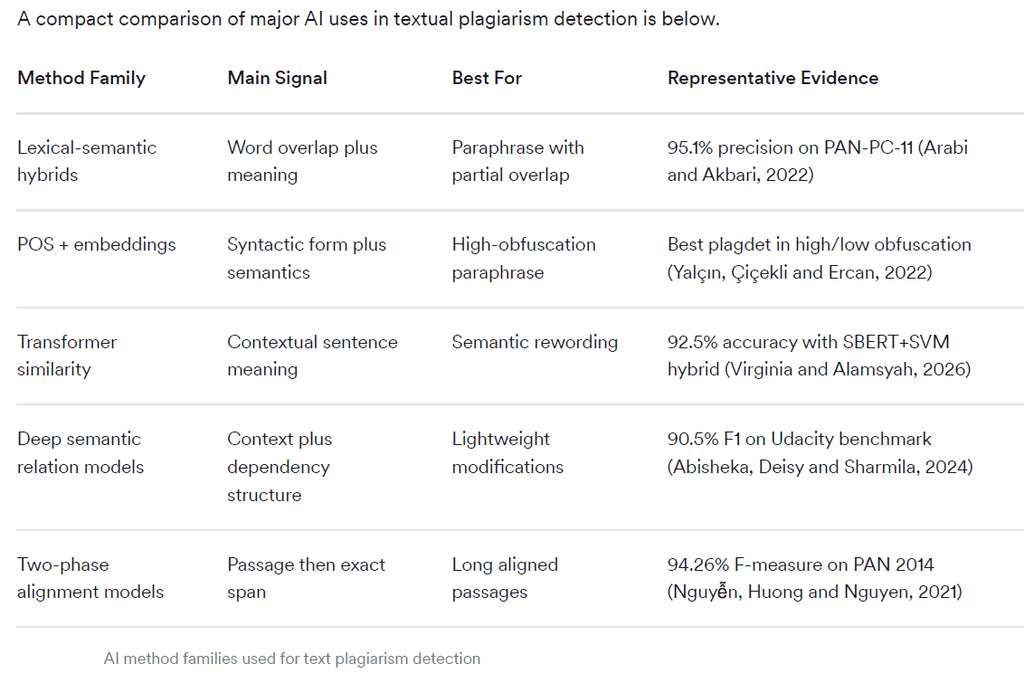
Research using word embeddings alongside syntactic features has shown particular benefits with heavily obfuscated paraphrasing. For example, Yalçın, Çiçekli and Ercan combined part-of-speech n-grams with Word2Vec semantic similarity and reported especially strong performance on high- and low-obfuscation passages in the PAN-PC-11 benchmark (Yalçın, Çiçekli and Ercan, 2022).
The useful part is not simply that the system “understands” text in some human sense. It is that meaning gives it another signal to compare when identical vocabulary has disappeared.
Why modern plagiarism detectors often combine old and new methods
It might seem logical that semantic AI should simply replace old-fashioned text matching. In practice, that is rarely the best solution. Some of the strongest plagiarism-detection approaches are hybrid systems which combine lexical and semantic evidence.
Exact matching is fast, interpretable and extremely good at detecting direct copying. Semantic comparison is more useful when words have been changed, but it can be computationally expensive and can identify passages that are conceptually similar without necessarily sharing a direct source relationship. Combining the two allows a system to exploit the strengths of each.
One approach, for example, can first use relatively inexpensive lexical methods to identify plausible source candidates and then apply more sophisticated semantic analysis to the smaller set of passages that remain.
Arabi and Akbari developed a hybrid weighted-similarity system using document- and sentence-level filtering followed by semantic comparison. On the PAN-PC-11 benchmark, their approach reported precision of around 95.1% (Arabi and Akbari, 2022).
That number needs to be understood properly. It is a result obtained by a particular system on a particular research dataset. It does not mean that a plagiarism checker using similar techniques will be “95.1% accurate” on every university essay uploaded to it. Nevertheless, results like this help explain why hybrid designs have become so prominent: simple methods can efficiently narrow the search while AI tackles the difficult cases.
What machine learning does in a plagiarism checker
Machine learning can be used at several stages of plagiarism detection. A classifier can be trained on examples of plagiarised and non-plagiarised text and learn which combinations of features best separate them. Those features might include:
- word overlap;
- sentence similarity;
- semantic similarity;
- syntactic structure;
- unusual word substitutions;
- phrase order;
- document structure; or
- combinations of many different signals.
Older machine-learning approaches have used algorithms such as support vector machines, logistic regression, random forests and neural networks.
Researchers have also experimented extensively with selecting the most useful features rather than feeding every possible measurement into a classifier. This matters because plagiarism is not one homogeneous phenomenon. Detecting a copied paragraph is different from detecting an intelligently paraphrased one. Detecting translated plagiarism is different again. A feature that performs very well for one may contribute almost nothing to another. Machine learning allows the system to learn which patterns tend to matter for a particular task.
Deep learning and transformers changed semantic detection
The development of deep learning – and particularly transformer models such as BERT – has made contextual comparison considerably more sophisticated. Earlier representations such as bag-of-words models largely treat words as items whose presence and frequency matter. Modern contextual models consider words in relation to the words around them. That distinction is important because meaning depends heavily on context.
Consider the word bank in:
She deposited the money at the bank.
and:
They sat on the river bank.
A simple word-matching system sees the same word. A contextual language model can represent the two uses differently because their surrounding language makes their meanings different.
The same principle can be applied to entire sentences and passages.
BERT-family models and similar transformer architectures have therefore been used for:
- retrieving possible source material;
- measuring semantic similarity;
- identifying paraphrases;
- aligning suspicious passages with source passages; and
- classifying whether similarity is likely to represent copied or transformed material.
One transformer-based system, T-SRE, combines contextual word embeddings with dependency parsing, named-entity recognition and structural analysis. On its Udacity benchmark, the researchers reported 92% precision, 89% recall and an F1 score of 90.5% (Abisheka, Deisy and Sharmila, 2024).
Again, those figures describe that experiment, not a universal accuracy rate. What matters for the wider picture is that combining meaning and structure allowed the system to recognise modified passages that conventional n-gram matching could struggle with.
AI is particularly useful against paraphrased plagiarism
Paraphrasing is one of the clearest examples of why semantic detection matters. A person trying to conceal copying can:
- replace words with synonyms;
- change active sentences to passive ones;
- reorder clauses;
- merge or split sentences;
- alter grammatical structures;
- add irrelevant words;
- remove details; or
- use a paraphrasing tool to rewrite the passage automatically.
The more extensive the changes, the less useful simple text overlap becomes. This problem became particularly visible with the arrival of automated paraphrasing tools.
Research into machine-obfuscated plagiarism has shown that conventional plagiarism software can perform much worse after copied material has been algorithmically rewritten. Foltýnek and colleagues investigated this problem specifically, while later work by Wahle and colleagues examined the identification of machine-paraphrased plagiarism using more sophisticated language representations (Foltýnek et al., 2020; Wahle et al., 2021).
That arms race has become even more relevant with large language models. A copied paragraph can now be given to a generative model and rewritten in seconds, perhaps repeatedly and with detailed instructions about vocabulary, tone and sentence structure. This is precisely the kind of plagiarism for which looking beyond literal word matches becomes valuable.
Generative AI has created a new plagiarism-detection problem
Generative AI affects plagiarism checking in two different ways. First, AI can be used by plagiarism-detection systems to find hidden reuse. Second, generative AI can be used to disguise plagiarism. Those are very different uses of AI.
The PAN plagiarism-detection benchmark has evolved to reflect this. The PAN 2025 task specifically examined generative plagiarism detection: finding automatically generated plagiarism in scientific text and aligning it with the underlying sources.
Interestingly, comparatively simple semantic retrieval using embedding vectors produced promising results, reaching recall of up to around 0.8, although precision was only around 0.5 in the reported baseline results. More importantly, approaches that worked well on the new dataset often performed substantially worse when tested on an older PAN plagiarism dataset (Greiner-Petter et al., 2025).
That is an important warning. A system can look very impressive on the benchmark it was designed around and still generalise poorly to a different collection of documents. AI does not remove the need for robust testing. If anything, it makes that testing more important.
Cross-language plagiarism is another natural use for AI
Plagiarism does not have to remain in the same language. A student could take a passage from a Spanish source, translate it into English and submit the translation without acknowledgement. An English-only exact-match search might find nothing.
This problem has been studied as cross-language plagiarism detection for many years. Researchers have explored machine translation, cross-language character n-grams, multilingual semantic representations and other ways of comparing material whose wording cannot possibly be identical because it is written in different languages.
Potthast and colleagues set out an influential framework for this problem, comparing methods designed to retrieve related passages across languages (Potthast et al., 2011).
Newer multilingual embeddings make the idea considerably more powerful. A multilingual model can represent semantically equivalent passages from different languages in a shared vector space. That can make it possible to identify that an English passage and an Arabic, French or German passage are discussing substantially the same thing even before literal translation is considered. This is one reason AI-based semantic methods are particularly attractive for cross-language plagiarism.
There are still significant difficulties. Performance varies across languages, resources are much richer for some languages than others, and long-document comparison remains challenging. Recent work on English-to-Arabic and Arabic plagiarism detection, for example, highlights both progress and the continuing shortage of high-quality multilingual datasets (Abdelaal, Elsaadany and Shamsi, 2025). AI makes cross-language detection more feasible but it does not make language differences disappear.
AI can look for changes in the author’s writing style
Most plagiarism detection is extrinsic: the suspicious document is compared with external sources. But what if the original source cannot be found? That is where intrinsic plagiarism detection becomes interesting. Instead of asking:
Which external document matches this paragraph?
an intrinsic system might ask:
Does this paragraph appear to have been written in a different style from the rest of the document?
This uses stylometry — the statistical analysis of writing style. Possible features include:
- sentence length;
- vocabulary;
- punctuation habits;
- function-word frequencies;
- syntactic patterns;
- word complexity; and
- recurring stylistic preferences.
AI can combine these features to build an approximate model of an author’s usual style and identify passages that depart significantly from it. Alsallal and colleagues combined stylometric analysis, latent semantic analysis and a multi-layer perceptron classifier to identify hidden authorship changes without relying on an external reference collection (Alsallal et al., 2017). This has obvious applications to ghostwriting and contract cheating as well as plagiarism.
It also illustrates an important distinction. An unusual shift in style is not proof that somebody plagiarised a passage. People naturally alter their writing according to topic, purpose, mood, editing and feedback. Stylometry identifies something worth examining. It does not provide the missing source or establish misconduct by itself.
AI can detect plagiarism in source code too
Source-code plagiarism presents a different technical problem. Simply comparing the visible text of two programs is inadequate because a copier can make many superficial alterations without changing the underlying program.
- Variables can be renamed.
- Functions can be reordered.
- Comments can be removed.
- Formatting can be changed.
- Redundant statements can be inserted.
- Control structures can sometimes be rewritten while preserving the same underlying logic.
Machine-learning and structure-aware approaches therefore analyse features beyond the literal characters in the file.
Research has applied machine intelligence to source-code plagiarism, while newer work has specifically considered AI-assisted code obfuscation – using tools such as ChatGPT to alter copied work in an attempt to avoid existing detectors. For example, Sağlam and colleagues evaluated a system against modelling assignments deliberately obfuscated using ChatGPT and found that a combination of automated analysis and human inspection improved resilience against these attacks (Sağlam et al., 2024). This is becoming increasingly important because generative AI makes sophisticated-looking transformations available to people who would not previously have had the skill or time to perform them manually.
Plagiarism detection is beginning to move beyond plain text
The next frontier is multimodal plagiarism detection. Academic work contains much more than paragraphs. It may contain:
- photographs;
- diagrams;
- charts;
- tables;
- equations;
- scientific figures;
- screenshots;
- scanned documents; and
- text embedded inside images.
Traditional text-matching systems can miss much of this, but AI offers several possible routes. Optical character recognition can extract writing embedded in images. Computer-vision systems can compare visual material. Multimodal models can analyse relationships between images and text. Citation analysis can identify suspicious patterns even where wording has been extensively altered.
Image and figure reuse can be a serious academic-integrity problem in its own right. Saliba and Rotzinger describe figure plagiarism and manipulation as under-recognised, noting that image checking still depends heavily on tools such as reverse image searching alongside human scrutiny (Saliba and Rotzinger, 2025). So while “multimodal AI plagiarism detection” sounds impressive, it is better viewed as a developing research direction than a solved problem.
The main AI methods at a glance
| Method | What it looks at | Particularly useful for | Important limitation |
|---|---|---|---|
| Lexical matching | Shared words and phrases | Direct copying and lightly edited text | Weakens as wording changes |
| Word/sentence embeddings | Similarity in meaning | Paraphrasing and semantic reuse | Conceptual similarity does not necessarily mean plagiarism |
| Machine-learning classifiers | Combinations of learned features | Distinguishing different similarity patterns | Depends heavily on training data |
| Transformers/BERT | Contextual meaning and relationships | Heavily paraphrased or structurally changed text | Computational cost and uneven generalisation |
| Hybrid systems | Lexical + semantic evidence | Practical large-scale checking | More complex to design and calibrate |
| Stylometry | Writing style | Ghostwriting and unexplained authorship shifts | Style can vary naturally |
| Multilingual models | Meaning across languages | Translated plagiarism | Uneven resources and performance between languages |
| Code/structure models | Program structure and behaviour | Obfuscated source-code plagiarism | Legitimate solutions can share structures |
| Multimodal AI | Text, images and other document features | Figures, scans and image-embedded content | Still comparatively immature |
The interesting point is that these methods are not mutually exclusive. A strong system may use several of them during a single scan.
AI may be used at several stages, not just for the final decision
It is easy to imagine plagiarism detection as a single classification task:
plagiarism / not plagiarism.
Modern systems are more complicated.
AI can be useful at several separate stages.
1. Source retrieval
From millions or billions of possible documents, which ones are worth comparing closely with the submitted text? Semantic retrieval can find candidates even when vocabulary differs.
2. Similarity analysis
Once a possible source has been found, how closely are the two passages related? A system can combine lexical, semantic and structural evidence.
3. Passage alignment
Which exact part of the suspicious document corresponds with which part of the source? This is particularly important when material has been reordered or extensively rewritten.
4. Classification
Does the relationship look like direct copying, light paraphrasing, heavy paraphrasing or something else?
5. Style analysis
Does part of the document differ substantially from the author’s surrounding writing?
6. Reporting
How should the evidence be presented so that a human can inspect the source and make sense of the result? This last stage is easy to underestimate. An opaque number saying “87% plagiarism” is much less useful than a report showing which passage was flagged, which source it resembles and why. The point of a plagiarism detector is ultimately to produce useful evidence, not simply an impressive probability.
AI plagiarism detection is not the same thing as AI detection
The terminology causes some confusion. An AI detector generally asks whether a piece of writing has characteristics associated with machine-generated text. A plagiarism detector asks whether material appears to have been copied or derived from another source. These questions are completely different.
ChatGPT can produce a paragraph which is original in the plagiarism sense: no matching source exists. An AI detector might flag it as generated.
Alternatively, a human can copy a paragraph word for word from a book. An AI detector may quite correctly classify the prose as human writing, while a plagiarism checker identifies the source instantly.
AI can be used inside a plagiarism-detection system without the system being an AI-authorship detector. That distinction is especially important now that both technologies are often sold alongside each other.
Why AI still cannot decide whether plagiarism has occurred
For all the advances described above, there is a fundamental limitation that has not changed. Software can identify similarity. But plagiarism is a judgement about what that similarity means.
Foltýnek and colleagues made this point clearly in their large evaluation of 15 text-matching systems: software can support the identification of similarities that may constitute plagiarism, but human evaluation is needed to determine what actually occurred (Foltýnek et al., 2020).
There are many legitimate reasons for two passages to resemble one another.
- A quotation may be properly referenced.
- A technical phrase may have no sensible alternative wording.
- A literature review may accurately summarise the same findings as dozens of previous papers.
- A student may have used a standard definition.
- Two programmers solving the same tightly specified exercise may independently produce structurally similar code.
A semantic model does not automatically understand the academic rules surrounding every one of those situations. Indeed, making a system more sensitive to meaning creates its own problem: not every semantic similarity represents derivation. Two passages can express the same established fact without one having been copied from the other. This is why evidence must remain traceable to sources wherever possible.
False positives and false negatives have not disappeared
Artificial intelligence does not abolish the two basic errors that affect detection systems.
- A false negative occurs when plagiarism exists but the system misses it.
- A false positive occurs when the system identifies innocent material as suspicious.
- Semantic AI can reduce some false negatives by finding cleverly paraphrased material that exact matching misses.
But increasing sensitivity can also create more ambiguous matches. This trade-off is particularly important when a system is used in education. A similarity detector is not merely retrieving interesting search results: its output may contribute to an allegation of academic misconduct.
Testing by Foltýnek and colleagues found substantial differences between plagiarism-support tools. Systems missed plagiarism and also sometimes reported non-plagiarised material as problematic (Foltýnek et al., 2020). The technology has advanced since that study, but the principle remains. No matter how sophisticated the underlying AI becomes, the cost of being wrong means that transparent evidence and human review remain essential.
Benchmark accuracy should be treated cautiously
Research papers frequently report impressive figures for new plagiarism-detection models. There is nothing inherently wrong with that. Benchmarks allow researchers to compare approaches under controlled conditions.
But several questions need to be asked before translating a benchmark result into a claim about real-world performance:
- What dataset was used?
- How was the plagiarism created?
- Was the paraphrasing performed by humans or machines?
- Which languages were represented?
- Were the source documents already known?
- How similar was the evaluation data to the model’s training data?
- Were short passages or whole documents tested?
- Was precision prioritised over recall?
- Does the model perform equally well on a completely different dataset?
The PAN 2025 results provide an excellent illustration. Semantic embedding approaches showed promising retrieval performance on the new generative-plagiarism task, yet many performed much worse when evaluated against an older PAN collection (Greiner-Petter et al., 2025).
A model can therefore be excellent at the problem represented by its benchmark without being universally excellent at plagiarism detection.
This is one of the largest remaining gaps in the research: the field contains many promising technical methods, but fewer large, independent evaluations of how they perform across genuine institutional submissions, disciplines, languages and forms of plagiarism.
Is AI better than conventional plagiarism detection?
The most accurate answer is that this is probably the wrong comparison. AI is not replacing conventional plagiarism detection – it is extending it. Improving it, I would argue.
For straightforward copy-and-paste plagiarism, conventional lexical matching is fast, efficient and interpretable. For heavy paraphrasing, translated text, concealed authorship, code obfuscation or other forms of transformed reuse, AI can add signals which simple matching cannot. The strongest practical approach is therefore often hybrid:
use inexpensive, highly reliable methods where they work, and use AI where the problem becomes harder.
That is why research increasingly combines lexical and semantic techniques rather than treating them as competitors.
Where AI plagiarism detection is heading
The direction of travel is fairly clear. Plagiarism systems are moving towards models capable of comparing:
- meaning rather than simply words;
- longer passages and whole documents;
- multiple languages;
- writing style;
- source-code structure;
- citations;
- images and figures; and
- several types of evidence at once.
At the same time, generative AI is making plagiarism easier to transform.
A student no longer needs to manually replace words throughout a copied paragraph. A language model can restructure it, translate it, summarise it, expand it, change its tone and produce several alternative versions in seconds. That makes exact matching less sufficient – but it also creates new opportunities for semantic detection. The result is something of an arms race between AI-assisted obfuscation and AI-assisted detection.
The long-term challenge is therefore not simply to build a model capable of finding more similarities. It is to build systems which:
- work reliably on unfamiliar material;
- explain why something was flagged;
- point back to identifiable sources;
- minimise innocent matches;
- work across languages and disciplines;
- resist deliberate attempts to defeat them; and
- provide evidence a human can fairly evaluate.
From copy detection to meaning detection
Artificial intelligence has not transformed plagiarism checking by giving computers a magical ability to decide whether somebody has cheated. Its contribution is more useful – and more realistic – than that. AI allows a plagiarism detector to examine relationships that are difficult to see through identical wording alone.
- It can ask whether two differently worded passages convey the same meaning.
- It can help find a source written in another language.
- It can notice that one section of a document has a markedly different writing style.
- It can compare the structure of computer programs after their variables and formatting have been changed.
- Increasingly, it can also contribute to the analysis of figures, scans and other non-textual material.
The biggest shift is therefore from copy detection to meaning detection. But the final distinction remains crucial. An AI system can identify evidence of similarity, derivation, transformation or unusual authorship patterns. It still cannot look at a highlighted passage and determine, by itself, whether the writer has committed plagiarism. That requires the source, the circumstances, the applicable rules – and human judgement.